Showing posts with label book report. Show all posts

Monday, June 1, 2015

W.B.'s Book Report: Dandelion Wine

Two of my favorites
For the last couple of weeks or so, I have been slowing savoring a book I first discovered as a teenager, and I found I am still under its spell.

It is a gift, to know with some degree of certainty that should anyone ever wish to know me - "Who are you, really, in your heart of hearts?" - that I can laugh and hand them a copy of Dandelion Wine and say, "Here, read this and know me, for this is my favorite book. Who am I, really, in my heart of hearts? Read Dandelion Wine and know what touches my heart. I am not any of the specific characters, I was not really a boy like Douglas Spaulding or any of his friends, but Ray Bradbury in describing his boyhood summer of 1928 weaves words that charm me like no other book, that recreate sights and sounds and aromas that he felt as an 8-year-old, and with words he plants those experiences into your own soul, woven with the summers you yourself have known in a way that helps you appreciate your own summers while assimilating his summer of '28.

For Bradbury - or at least for his fictionalized Douglas Spaulding - it was a season of realizing the miracle of being alive - and a season of suddenly and slowly realizing that life comes to an end - and such adventures in between.

Who am I, in my heart of hearts? I am someone who loves books, and this is my favorite book. I am someone who loves, like an old friend or favorite uncle or even a cherished lover, this book. These stories. These turns of phrase. These memories.

It's all there, the summer of 1928 as experienced by a boy in Green Town, Illinois, captured in glass bottles of yellow wine and transformed into succulent words.

Oh, there must be better books. In my lifetime I will read a fraction of all the books that have ever been written. All I know for certain is this book that delighted me as a teenager charmed and thrilled me again in my early 60s, like no other book each time.

This time I read it in bursts, a little at a time, over more than two weeks, although it is a short novel as novels go these days - 184 paperback pages. I remember picking it up once in between, a few years back, and starting to read but not being touched the way I was the first time. I wonder if it was winter then. I wonder if this book needs the soundtrack of the birds calling outside the window, the warmth of spring and music in the air, to come alive. It certainly enchanted me again this past half-month as it did more than 40 years ago, when I devoured it in a rush.

And so I declare it my favorite book - perhaps not the greatest literary triumph, although perhaps it is, because what it literature if not an attempt to capture the human experience in words? No matter. I am grateful Ray Bradbury lived, that he set the summer of 1928 to music, and that I encountered this masterwork at two of the moments in my life that I was most receptive to its beauty.

Monday, March 16, 2015

W.B.'s Book Report: The Martian

“Cast Away meets Apollo 13” is how more than one reviewer describes Andy Weir’s compelling page-turner The Martian. In a world where everything needs to be a reference to something else, I suppose that description works as well as any.The plot of the book does indeed contain elements that will remind the reader of both movies, although Mark Watney never befriends a volleyball.
And it doesn’t cover Weir’s unique voice, the humor, and the care taken to walk that thin line between realism and the absurd. For all of the headaches and dangers that Weir sends the way of his astronaut stranded on Mars, I never once said “Oh, come on, now you’ve jumped the shark,” or “Oh, please, that solution was way too convenient.”
This is a great novel that takes readers to the real Mars — as real a Mars as contemporary science can speculate — and never lets up until the story reaches its powerful conclusion.

Thursday, August 7, 2014

W.B.’s Book Report: Life is short and so is this Book

… and this will be a short book review. This is one of those little books that condenses the wisdom of the ages into a very small package. And it does this very well.

Just the table of contents – the names of the 10 chapters – comprises a good philosophy of life: Create space. Try not to worry. Don’t do really dumb things. Build character and make friends. Care for yourself and others. Laugh. Do what you love. Embrace change. Learn from experience. Have dreams and work toward them.

Peter Atkins’ little book is worth reading and re-reading – it will reward you every time.

Saturday, August 2, 2014

W.B.’s Book Report: The Beam, Season Two

A mere 83 years from now, nanobots in your bloodstream can help you live young and vibrant well past your 100th birthday, and immersive computer technology can deposit you into a reality so real you can’t tell if it is. Ri-ight.

Well, why not? Eighty-three years ago in 1931, movies barely knew how to talk and the most advanced electronic device in most homes was a radio. How far we’ve come – and how far we are going.

But the vision of the future and its toys are not what makes good science fiction. It’s the stories about the people who live in that vision and play with its toys. Sean Platt and Johnny B. Truant are great storytellers.

What they have created is a world where, much like today, the devices are more advanced than ever but the same old barbarism lurks in the human heart. We never manage to keep up. Humanity is still divided between those who want to earn their living and those who want the good life handed to them as a right. In the Beam World there are still those who believe they know better and deign to manipulate us into shape, with tools more capable than ever of making it so, while keeping the best of the good life for themselves. And in 2097 the manipulators still offer us a non-choice of two parties that appear, after scratching not too far below the surface, to be not as different from each other after all.

Tuesday, April 22, 2014

W.B.'s Book Report: The Book Thief


And there it was, as the Kindle told me I was passing 95%, a rare and welcome surge of sadness, not because the book is coming to a sad ending, but simply because it is coming to an ending. The author earns the tears with his characters and storytelling, but the tears are also from the ache of a beloved journey reaching its destination.

The lyricism of Markus Zusak’s words, and the turns of his remarkable story, are hard to let go. Zusak pulls us gently into the story of Liesel Meminger and makes us love her, along with her adopted and extended family. The Book Thief, I suspect, will be remembered as one of the greatest works of early 21st-century literature, but if my suspicions are wrong, it will still be a book that lingers with me personally until its narrator comes to visit me.

I watched the wonderful film that has been made of The Book Thief after I’d finished about a quarter of the novel, and I was struck by how well the movie honors the book while ably transforming the story from one medium to another. Inevitably, the book is a deeper and richer experience, but the film is worth the investment of time as well.

The decision to buy and read this book came after a reader I respect said she would rank it with To Kill A Mockingbird among the best she’d ever read – the highest of praise. I knew little more about the story, and for those who want to discover the book as I did, I’ll leave it at that. Highly, highly recommended. 

Monday, January 27, 2014

W.B.’s Book Report - Doc Savage: Skull Island

Fans marked the 80th anniversaries of two iconic characters in 2013: Doc Savage, Man of Bronze, and King Kong. Longtime Doc historian and modern author Will Murray celebrated the occasion by composing a rousing prequel that merges the best of both myths into a fairly seamless whole.

The early chapters and epilogue of Doc Savage: Skull Island are set in the hours and days right after Kong plummeted to his death from the Empire State Building, where up on the top floor Clark Savage Jr. had established his offices and laboratories with a stalwart band of five fellow adventurers. His friends tell the story of the mysterious great ape that was just felled by Navy warplanes and are astonished when their bronze-skinned leader says softly and sadly, “I know this creature.”

“Long ago, he saved my life,” intoned the metallic man.

Ham Brooks and Monk Mayfair lost all power of speech.

“And I returned the favor in kind,” said Doc Savage.

Doc and his men take on the grim task of removing the body and preparing it for return to Skull Island, the wild land that time forgot where Kong had ruled for many years. Once that task is underway, Doc sits down with his friends to tell a story that begins shortly after the Great War ended and they went their separate ways, and 19-year-old Clark Savage Jr. is summoned by his seafaring father. Clark Savage Sr. has received a clue to the whereabouts of his own father, Stormalong Savage, who has been missing for some years.

Murray’s story logically fills in the clues to Doc’s past left by Lester Dent/Kenneth Robeson through the years and places Kong square in the middle of the Savage mythology. At 412 pages in print, it’s three times longer and more wide-ranging than any of the classic Doc Savage pulp novels, but the story deserves the more epic treatment.

As someone who also has thoroughly enjoyed Doc over the years (to the point where I’ve created my own series of pulp adventures) and considers the 1933 King Kong film as one of the all-time triumphs of adventure fantasy, I had a ball with Murray’s loving treatment, and I unhesitatingly recommend Doc Savage: Skull Island. It may well be a good entry point for yet another generation to discover Doc and his band all over again.

Thursday, January 9, 2014

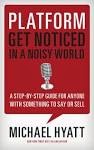
W.B.'s Book Report: Platform – Get Noticed in a Noisy World

http://www.amazon.com/Platform-Get-Noticed-Noisy-World-ebook/dp/B006T364QG
For anyone who wants to establish or improve an online platform, Michael Hyatt has written a detailed, nitty-gritty handbook. From the most very basic foundation – create a compelling product – to interacting with your tribe via Twitter and other social media, Hyatt gives enough detail to get the reader started while encouraging us to find our own voice. Platform is essential reading for 21st century entrepreneurs.

Friday, July 5, 2013

W.B.’s Book Report: Unicorn Western

It began as a laugh among friends. It has evolved into a nine-novella epic with the promise of two more epics to come. The story of how Unicorn Western came to be is almost as much fun as the actual story.

Sean Platt and Johnny B. Truant are two-thirds of a podcasting team that meets weekly to talk about writing and self-publishing. One day the other third, David W. Wright, took exception to Platt’s stated desire to write a western someday. Too much trouble, too much research needed to make it authentic – for example, do you know what color was the smoke from those old six-shooters? Hilarity ensued.

The solution to Wright’s objection: Put a unicorn in the story. That way when people question what appears to be an unrealistic detail, you can respond that this isn’t the real Earth: “If we’ve filled the world with unicorns, I’d say we can do anything we want!”

 A few short months later, the joke is a series of novellas available as ebooks separately or in ebook and print as Unicorn Western: Full Saga – a sprawling tale of magic and prairie justice that spans decades and pays homage to at least nine films along the way. (Because I need an occasional break from electronic screens, I opted for the 690-page book.) There are plenty of in-jokes and winks that will bring a knowing smile or a laugh-out-loud to people familiar with the films and The Self-Publishing Podcast – my favorites are the prophetic owls – but the story creates a mythology all its own and stands up as a rousing yarn despite its goofy origins.

This is not Atlas Shrugged or even Lord of the Rings – the main thing it has in common with those works of literature is its length – but the payoff is definitely worth the long ride; the authors entertain and make you care along the way. Unicorn Western is the reader’s equivalent of a summer blockbuster movie, well worth the time invested and leaving you with anticipation of the sequel(s).

Wednesday, November 23, 2011

Unplugged and loving it

[Found in notebook, written April 20, 2011]

In his influential book Thou Shall Prosper: Ten Commandments for Making Money (I describe it as influential because it has influenced me so deeply), Rabbi Daniel Lapin encourages his readers to make goals and delve into their life’s purposes but not before spending two or three days avoiding all electronic screens. Those brightly colored images have a mesmerizing effect, much like a deer confronted by headlights, Lapin said. Better to clear the mind before focusing on weighty matters.

Monday, November 21, 2011

W.B.’s Book Report: Letters of a Self-Made Failure

Here is a timely relic from nearly 100 years ago. Maurice Switzer wrote a series of 10 letters, ostensibly from a man who took a circuitous route to contentment and addressed to his younger brother, who is newly embarked on this adventure we call adulthood.

Thursday, October 20, 2011

The power of short books

Books are getting shorter. The Domino Project launched by Seth Godin and friends has been publishing a series of manifestos, as they call them, all fewer than 100 pages and 5.25" by 7.5" – and all of them pack quite a punch. They took it to an extreme Wednesday with the release of what they're calling a "one-page book," a poster detailing the federal budget.

My own A Scream of Consciousness and Refuse to be Afraid run about 90 pages, in part because, well, I said all I needed to say in that space.

In his introduction to his translation of Abandonment to Divine Providence, a k a The Sacrament of the Present Moment, John Beevers writes:
Short books often have great power. A few that come to mind are Thomas à Kempis' The Imitation of Christ, the Communist Manifesto, Paine's The Rights of Man, Rousseau's Social Contract, St. Thérèse's The Story of a Soul and, of course, the Gospels. There is a very human reason for this. Most people have neither the time nor the inclination to plough through a five-volume treatise. They want the message, whatever it is, given to them in as few pages as possible. This is no new phenomenon. Pamphlets may not give as much enjoyment as a many-volumed book, but it is arguable that they have had vastly more influence.

And it is not only the reader who is affected by a short book. Its writer is. The effort, whether conscious or not, to concentrate his thought into a hundred or so pages instead of a thousand, gives this thought a sharpness and urgency which would inevitably be diffused over many volumes.
I would heartily recommend the Domino Project books – Godin's We Are All Weird or Poke the Box, Read This Before Our Next Meeting by Al Pittampalli, Anything You Want by Derek Sivers, or Do the Work by Steven Pressfield, for example – or of course my own humble efforts (see the right sidebar for previews).

I'm not going to suggest that these are as good as those books Beevers rattled off, but they do pack a punch, if I say so myself.

The Sacrament of the Present Moment, of course, plays an integral role in the ideas in A Scream of Consciousness. From the pages in the Amazon preview I think Beevers' translation might be a little more accessible than the one I read by Kitty Muggeridge, but it's the ideas of Father Jean-Pierre de Caussade that resonate in any case.

Happy reading!

Tuesday, July 13, 2010

Self Help: Words that could have been written this morning

I am still amazed that the opening paragraphs of Samuel Smiles' book Self Help were published in 1859. Except that he uses an occasional word or turn of phrase that people don't use anymore, Smiles could be writing about the contemporary debate about government bailouts versus the power of the individual and the private sector.

Smiles' book is packed with examples of real-life (19th century) success and encouragement. No wonder it created an entire new genre. I'm tickled to be in a position to re-introduce this classic to modern audiences. Check this out (and click on the book cover to find out how to buy or download it):

Saturday, June 26, 2010

W.B.s Book Report: Thou Shall Prosper

Rabbi Daniel Lapin's book is one of those eye-opening, game-changing books. He purports to explain what money is and how money works.

The laws of the marketplace don't change — you can try changing the rules as governments often do, but it won't work. Lapin explains the rules as clearly as I've ever seen, drawing on the ancient teachings of the Torah itself.

Business and money itself, Lapin says, are products of humanity's spiritual nature. As such they only work well when values like trust and integrity are at play. Again, some folks find temporary success with business and money without trust or integrity — but the emphasis there is on temporary.

This is one of those rare books that needs to be read more than once — studied and absorbed. I would be doing a disservice by trying to relate its concepts based on my still-growing understanding.

This much I can and will say: The attitude of our nation's leaders and most entertainment venues toward business and business people is based on falsehoods and a complete misunderstanding of the free market. I knew that much instinctively before I picked up this book, and Lapin does a nice job of explaining why it's true.